My first attempt at registration wasn’t pretty. The complicated template I created consisted of a dizzying number of overlapping rectangles (representing positions of the different blocks) that ended up looking like something Piet Mondrian tried, and then discarded in shame. I was barely able to produce one almost passable print before I called it. The “edition of one” was complete because there was no hope of the registration ever lining up again.

There are many aspects to relief printing which make this a medium that is accessible to anyone, regardless of experience. It turns out that for me, registration was not one of them. A little internet research helped me learn pretty quickly, especially about pin registration. Considering how badly my first attempt went, the fact that I was able to get this to work so exactly should give everyone hope. So for anyone out there struggling with registration: read on!
PIN REGISTRATION
The concept of pin registration is pretty basic. You have a fixed set of pins that maintain a consistent position in relation to the block you are printing. Then the paper slips onto the pins, making sure that it is always in a consistent position as well. If both the block and the paper are in consistent positions, then everything lines up. Since the pins are fixed, that makes the process repeatable. Same position, each and every time.

While I understood the concept, I still needed a little handholding to figure out how to actually do pin registration.
Fortunately for me, there is the Ternes-Burton Co. They produce registration pins that consist of a flat metal body which has perfectly sized pins on it. The flat body makes it simple to affix the registration pins to a flat surface so they won’t move.
They also produce stripping tabs, flexible plastic strips with a hole made specifically to fit their registration pin. These tabs can then be taped to the back of the paper you are going to print on.
After a little setup, the paper (now with tabs) can be easily snapped into place to get the consistent, repeatable placement that pin registration requires!
It turns out that the Ternes-Burton Co. is right in my own backyard, only 2 miles from where I live. If I hadn’t been sold already (I was) the fact that I was buying local tipped the scales. My order arrived in a few days, and it was time to test them out.
POSITION OF THE BLOCK
While the registration pins and stripping tabs would maintain the position of the paper, I still needed to figure out a way to guarantee a consistent position of the block.
I knew I would need a flat surface I could tape the pins firmly down to. Ideally that surface would be about the same height as my lino block. If the heights were mismatched, the paper would need to curve up or down to reach the surface of the linoleum, and I worried that could make it hard to repeat the exact position. I also needed something that would help me make sure the lino block itself could be placed in the same position each time.
I scoured my random art and hardware supplies to see what I could find, and came across a piece of wood that was about the same height as my lino block. I also found some right angle brackets: the idea being the brackets would set the position of the block against the wood, allowing me to slide the linoleum in and out so I could ink between prints.

Putting this together was simple, even for me. I started by placing my block up against the wood, roughly in the middle, then placing the first right angle bracket on one side and tracing where the screws would go. I quickly drilled some pilot holes, screwed the first bracket into place, and then repeated on the second side.
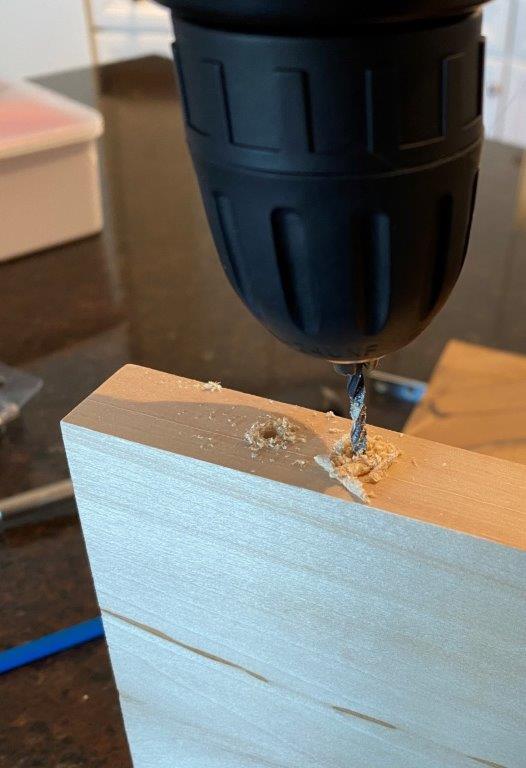


I made this fit pretty snuggly. I wanted something that wouldn’t have any wiggle room which could potentially throw off the registration. Maybe I got lucky with how well this worked out (I am not experienced in woodworking at all) but this accomplished exactly what I had hoped for. The linoleum block now snapped into position easily, but once in, it felt locked into place.
POSITION OF THE PINS AND PAPER
Now it was time to use the registration pins. Since the linoleum was already set, the positioning of the pins would be entirely dependent on the size of the paper, and where I wanted the image to land on that paper.

I was using a heavy western paper. I love this paper, but it has absolutely no transparency. So while I knew the size, trying to get the image area centered where I wanted it would be complete guess work.
A sheet of acetate solved this for me. I traced an outline of one of the sheets of paper onto the acetate, then laid that over the top of the linoleum block that was already in position. By moving the acetate around, I could see the boundaries of the paper in relation to the lino block, and understood exactly where the image would fall. Once I was happy with the position, I taped the acetate down to the flat block of wood.
Now I took out the two registration pins I was going to use, and I snapped a stripping tab to each of them. The pins themselves need to be positioned outside the boundary of the paper, with the stripping tabs extending onto the paper enough to make sure I could tape them down firmly so they don’t move. This was so easy with the acetate! I just slid the pins (with the tabs) around until the pins were outside of the paper, and the tabs would fall on the paper. Once there, I taped the registration pins down.

ADDING THE STRIPPING TABS

The final setup step was to put strips on the backs of each sheet of paper I was going to print on. The acetate also helped with this phase; I just left it in place so that I could quickly drop a sheet of paper on top, then slide it around until it matched the traced outline of the paper. Then I snapped two new stripping tabs onto the pins, and taped them to the back of the paper. Simple!
All in all there was a little bit of setup, but if the registration worked out, it was more than worth it. So the only thing left to do was to test it out.
PRINTING
Aside from wanting to learn about registration, I also wanted to try a reduction cut. A reduction cut uses a single block, but the block is “reduced” between the printing of each layer by carving away more of the printable area. This method is very dependent on registration, and it seemed like the perfect way to test the pins out.

Even while printing the first layer, I was impressed. I didn’t have to mess with trying to position the paper at all; that was taken care of during the setup! All I really needed to do was ink up the block, snap it into place, and the clip the paper onto the registration pins. It made printing really fast for me… so fast that I believe I will use the Ternes-Burton pins and tabs from now on, even if I am printing an image that only has a single layer.
The first layer was exciting; the image was in the exact same place on every sheet of paper. This was definitely more consistent than I had been able to produce in the past. But the real reason for all of this was to be able to register more than one layer.
After a week of drying, I was finally ready to attempt the second layer. I would be lying if I said I wasn’t pretty anxious. That moment slowly peeling back the paper on the first print, listening to the soft tackiness of the ink, and waiting to see if it worked out? The tension was excruciating. But…
… the results were incredible! The video below does a better job of explaining how well this worked than I can in words. All I can say is that I printed 18 sheets, and the registration was literally perfect on every single one of them!
CONCLUSION
Prior to this, I held back from even considering any image that would require layers. I was certain that I wouldn’t be able to make the registration work. It was a limiting factor to what I could actually do with relief printing. That anxiety is gone. Now I feel confident that I can nail registration, which means that I am free to dream up any image I want!
I don’t think I will ever print without the Ternes-Burton registration pins and stripping tabs again. I am impressed by the quality of their products. They are reusable, and sold at an unbelievably affordable price. They made my printing process more efficient by simplifying the positioning of the paper. Most importantly, I now know that each layer will end up exactly where it is supposed to be.
I highly recommend checking them out at: www.ternesburton.com.
POSTSCRIPT
As I was writing this, I found a post about another interesting use of the Ternes-Burton registration pins; one that I will definitely be incorporating into my printing process!
Handprinted (a fantastic resource for printmakers!) demonstrates how to use the Ternes-Burton pins to position a mylar mask over a lino block to eliminate ink chatter that can interfere with a final image.
Check the post out here! You can also find them on Instagram as @handprinteduk.